|
|
 |
|
|
|
History of Yukon First Nations People |
|
|
Click a category, or scroll the page |
|
 Timeline Timeline |
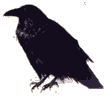
According to oral tradition, the Yukon First Nation peoples have lived in this land since Crow, a mythological creature of the time, made the world and set it in order. Archeologists calculate that the first humans inhabited the Yukon more than 10,000 years ago, crossing the Bering land bridge, from Asia. Today, the First Nations peoples belong to the Athapaskan or Tlingit language families.
| 7,200 years ago | earliest archaeological site in Southwest Yukon found so far |
| 1898 | Klondike Gold Rush |
| 1902 | Chief Jim Boss made a plea to the Government of Canada and the King to begin treaty or land claims discussions with the Yukon First Nations |
| 1923 | The Indian Act was introduced |
| 1941 - 1945 | Construction of the Alaska Highway |
| 1969 | White Paper: Federal Government rejects aboriginal title claims and proposes ending of treaties |
| 1973 | Together Today for Our Children Tomorrow presented to Prime Minister Pierre Trudeau by Elijah Smith |
| 1984 | Rejection of the first draft land claims agreement |
| Groups |
The majority of Yukon First Nations peoples belong to one of the Athapaskan and Tlingit language families:
Gwitchin (Old Crow),
Han (Dawson City),
Northern Tutchone (Mayo, Carmacks, Fort Selkirk, Pelly Crossing),
Southern Tutchone(Whitehorse, Haines Junction, Burwash Landing, Champagne),
Kaska (Ross River, Watson Lake, Liard),
Tagish (Tagish),
Tlingit (Carcross, Teslin),
Upper Tanana (Beaver Creek).
| Language |
In recent years, there has been a resurgence of interest among many Yukon First Nations peoples in their native language. The Yukon Department of Education working with the First Nations Educational Council and the Native Language and Cultural Curriculum for school children. Many traditional Yukon Natives "Owned" special words that were believed to have great power. Their owners used the words to protect themselves from bears or from dangerous waters, to ease pain, to cure a knife cut or bullet wound, to increase their ability to shoot straight, to pack heavy loads, or to have an easy trail. Sometimes the words were sung, sometimes they were just thought silently."
-Catherine McClellan
| Spirit
Lodges, Houses and Burial
Sites |
Native people were originally cremated. Spirit houses were built as a home for the ashes and sometimes personal effects. Though Natives began burying their dead in the second half of the 19th century these lodges are still built on top of the burial site. Spirit Lodges are respected as the resting-place of the dead and tourists are requested not to visit these areas or take photographs. These and other Yukon First Nation burial sites are sacred places that are now protected under land claims agreements. Markers, spirit houses, and related artifacts and bones cannot be disturbed. Any accidental discovery of such a site, which might be found near old villages, camps and trails, must be reported.
| Clans |
Traditional Yukon First Nation social and political organization is based on two clans, Crow and Wolf Clan membership is matriarchal. The rule of opposite clan Marriage stipulates that Crow must marry Wolf, ensuring that there are always ties between clans and between people from distant places.
| Traditional Life |
Yukon First Nations made their living hunting, trapping and fishing. Large groups gathered in summer to catch spawning salmon and in fall to hunt migrating caribou. Moose and sheep were also hunted. In the winter and spring they dispersed into small family groups to hunt, trap and fish. Life in the northern forest required mobility, so some materials and food were made and cached at traditional campsites along well-established trail systems. What people did carry from place to place was knowledge -a profound understanding of the land and how to live on it. To this day, subsistence hunting, fishing and trapping is still carried on within the First Nations' traditional lands. Watch for and do not destroy cache poles and other structures at traditional campsites. There is a growing interest among First Nations people in recapturing the traditional ways of life, including language, songs and culture.
| Spirituality |
Yukon First Nations possess a strong spirituality based on an ancient oral tradition and an inherent respect for the land, the forces of nature and the animals and plants they share them with. Spirits are sensed throughout the natural world, in the land, the water, the plants and the animals. It is of great importance to maintain a balanced relationship between all these forces. Native spirituality teaches how to heal people who are sick, how to live off the land in harmony and how to develop spiritual power. Native spirituality is a lifestyle. According to ancient beliefs each person on earth is given a special gift by the creator and has a lifelong responsibility to develop that gift for the benefit of the whole community. The advent of missionaries led many Yukon Natives to accept the European notion of god and the gospel of Christ, but the undercurrent of traditional spirituality address many of the heartfelt concerns of the people who must know the land intimately in order to survive on it well.
| Spirit Power |
All the traditional Yukon Indians thought there were many spirit powers in the universe, some were more powerful than the spirit powers of humans. The old stories do not make it altogether clear whether the spirit powers had worlds of their own and just came to the human world when needed, or whether some stayed in some parts of the human world. In any case, every Indian depended on these spirit powers for a good life. It was believed that the spirit powers could give good luck or added powers to humans, helping them in many different ways. The problem was that each Indian had to believe in the right way in order to get the spirit powers and could give good luck or added powers to humans, helping them in different ways. But if a person did the wrong things or had wrong thoughts of the spirit powers, everything would go badly.
The Indians said that almost anything could have this quality of power, because it came from spirits that could be in almost anything. It could be in a mountain, a lake, an animal, a human being, an arrow, a bullet, a knife, menstrual blood, and so on. Some spirit powers were said to be very strong, while others were very weak. Spirit powers were often hidden, its presence might go undetected until someone with the proper knowledge tapped into it and used it for himself or someone else.
Some Signs of the presence of spirit powers were well known by all.
| Politics |
With the arrival of Europeans during the gold rush came the economic and political institution of the south, causing profound social, economic and political change to the First Nation. The Alaska Highway had a strong impact on Natives, opening some communities for the first time and determining the future location of others. Today one of the most important issues to Yukon First Nation peoples is the settlement of land claims. The roots of the Yukon Land Claims go back to the Royal Proclamation of 1763 that required treaties with aboriginal peoples. However, treaties were never signed between the Yukon Natives and Canadian Federal Government. The recent history of the land claim process began in 1973 when a delegation of Yukon Indian people, headed by Elijah Smith, presented "Together Today For Our Children Tomorrow" to the Government of Canada. This document was more than a statement of grievances. In it, Yukon Indian People made clear their desire to protect their cultures and develop economic opportunities for future generations. Twenty years later, in 1993, the Umbrella Final Agreement (UFA) was signed, setting the stage for the completion of modern-day treaties for each of the Yukon's 14 First Nations. Four of these First Nations Final Agreements came into effect in 1995,and the goal is to complete the remainder by the year 2000. The agreements recognize the interests and rights of First Nations to protect the land and resources, which have sustained them for thousands of years. The agreements provide the First Nation with 16,000 square miles of land, financial compensation, and a clear role in managing natural and heritage resources throughout the Yukon. Self-government agreements were also negotiated and give First Nations more legal control over the management of their own affairs and land. The land claim agreements are historic milestones that will guide the Yukon's economic, political and social development well in to the next century.
| Klondike Gold Rush |
The First Nations played an important role during the Klondike Gold Rush in the late 1800's. They contributed by utilizing their traditional knowledge of surviving in this country for thousands of years.
One of the most significant contributions was the fact that the two co-discoverers were Yukon First Nation's people. They were Skookum Jim and Tagish Charlie. These two men found the gold but they could not register the claim in their own names because of the fact that they were First Nations. Their claim was registered to George Carmacks, who was Skookum Jim' s brother in law. He was married to Kate Carmacks, Skookum Jim's sister.
Other significant contributions by the First Nations include:
- Laying out the best possible routes to the gold fields
- Helping pack tons of required supplies over the treacherous Chilkoot Pass
- Building boats at Lake Bennett
- They sold traditional clothing to the gold seekers - i.e. mukluks, mitts, parkas, etc.
- They taught survival skills for this harsh climate
- There are stories of the First Nations providing/supplying wild game to the gold-seekers
- When the steamboats were operating, First Nations supplied the majority of the wood required to run the boats. The wood camps are located all up and down the Yukon River.
The First Nations did not hold much value for gold in those days. The metal was too soft to work with. Copper was more valuable to the First Nations.
| Arts & Crafts |
Many Yukon First Nations people are gifted artists and artisans, drawing from traditional practices and materials, yet using certain modern approaches. The range of expression is wide-from all aspects of the visual arts to music, dance, song, stories, poems and plays. The Native arts organization SYANA (Society for Yukon Artist of Native Ancestry) regularly holds exhibits. Beautifully beaded moccasins, baby belts and mukluks can be found in a variety of galleries and shops. Carvings, jewelry and masks may be made from antler bone, wood, mastodon ivory or horn. The Yukon International Storytelling Festival, Yukon Native Arts Festival, Native Folklore and Yukon Indian Days are exciting activities that take place throughout the year and are hosted by the Yukon First Nations peoples.
 |
VIEW THE FIRST NATION ART GALLERY (this will open a new window) |

|
|
|



 Timeline